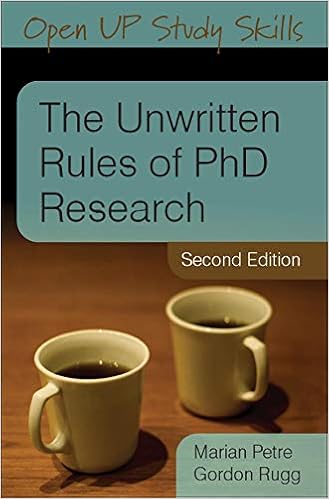
As part of my Doctor of Theology program at Forge Theological Seminary I am completing several preliminary foundational “seminars,” including reading through several books on dissertation development and production.
This book in particular, Unwritten Rules of PhD Research, just happens to be the very LAST book to be read in Phase I of my doctoral program. With a short break (this weekend), starting next Monday I will be launching head-long into Phase II, researching future persecution against the American Church and how the Christian response to that persecution should be informed by a robust philosophy of death and an Enochian Worldview.
So, let’s get this party started, shall we? The last book I’ll probably ever read or review on how to write a doctoral dissertation….
Overall Impression of the Book
A Dissertation in grad school and especially in a doctoral program is not a mere report or research paper. It does not draw its credibility from a few sources found on the internet or in the local newspaper or magazine (Petre, Unwritten, 74). It is an argument solidified in rigorous inquiry into a given subject, attempting to answer a question. It is not a textbook, which students in high school or undergrad complain about reading (Petre, Unwritten, 81). Rather, it is an advanced text written by an authority in a given subject, most often someone who has written journal articles on the same or a similar subject, and is attempting to demonstrate a certain level of competence in the field.
There are specific means by which that competency is demonstrated: in the mastery of a subject, acquiring insight, independence, and the oft sought ability to communicate their results effectively (Petre, Unwritten, 2). In fact, there are three major areas in which a student progresses when undertaking a PhD or ThD, moving from the preliminary materials and requirements that serve to orient the student away from simple reception or acquisition of knowledge to the role of the scholar. Once firmly oriented, the student moves into the research portion of the program, a time of intense discovery, exploration and formulation of pertinent questions. At last, the student emerges from this second area and transforms his or herself again, growing and extending the skills needed to discuss and communicate what they have become an expert in (Petre, Unwritten, 18).
This book provides a great deal of insight into this metamorphosis. It speaks at length on how to study, how to conduct research, what it means to have a supervisor, how to read (like a scholar), how to think, how to present your findings, as well as what life might be like after the completion of your doctorate.
One important element of the dissertation I found useful that they discussed was the literature review. They argued that the lit review was not just a review of a collection of academic writing, but was a “well-founded base” from which the researcher could draw in support of their thesis (Petre, Unwritten, 156). In that research phase of the program there is no randomness to the inquiry. It is not a matter of collecting random sources simply because they are required. In fact, in most programs, the number of resources is not even discussed. It is not like in undergrad or high school where the instructor identifies the minimum number of resources a project paper is required to have. In the same vein, the literature review is not a summary of every item available on the subject either. It must serve the explicit purpose of defending and supporting the researcher’s thesis.
Another interesting point brought up was the famous story of the woman who lifted a car off her child after they were involved in an auto accident. It is a well known – even legendary – story. Yet, the author states, categorically, that the story is actually an urban myth (Petre, Unwritten, 195). Needless to say, this perked my curiosity. With a little investigation, I discovered this phenomenon is known as hysterical strength (Bowman, “Strength,” 92-107). Whether the author was referring to the lack of “scientific, laboratory” evidence is unclear, but there are a host of anecdotal examples: such as people in general lifting cars off loved ones when the vehicle falls off jacks, or adults fighting a polar bear to save children. It is even said that the author of the HULK got his inspiration by watching a woman lift a car off her baby (Hill, “Green”).
Some of my Thoughts
There were, of course, some really great points brought up by the author concerning the dissertation and academia in general. They mention the concept of students learning a general academic language (Petre, Unwritten, 150) as they pursue their studies. With this concept I completely disagree. A special academic language does in no way signal membership in a certain community or illustrate any kind of specialized knowledge. It is actually the kind of thinking pervasive in academia that has led to the ivory tower being insulated from the real world for far too long, and many of its inhabitants have atrophied – to be honest, many of them have gone completely insane. Just look at what they are positing as knowledge today.
Another story they recounted I don’t think I will ever forget. It’s quite amazing to me how people can devote themselves to a concept, an idea, a theory – spend countless years on research and analysis, defending and arguing and connecting the dots – only to discover in the end that their original hypothesis was incorrect or they had been misled by the data at some point along the way. It is truly a tragedy. In the book, they told of a student who spent several years working on his PhD for mushrooms, to show how the plants can be grown more efficiently and more quickly. In fact, during the research, the student discovered not only an incremental increase but an exponential circular growth pattern to the data he collected at a greenhouse that grew the mushrooms in question. At his dissertation defense, upon looking at the data for a few minutes, one of the professors looked at this young man and asked, “Did you account for the central heating system in the greenhouse?” Upon closer inspection, all the student was really tracking in his data was the response of the plants to the cycles of the central air turning on and off (Petre, Unwritten, 194).
Couldn’t this just as easily be said for the likes of Origen, who argued for a kind of quasi-reincarnation of humans as they karmically move between the states of demon, human, and angel? What do we make of Tertullian’s certainty that the Book of Enoch was inspired Scripture? Later in life he made peace with the assertion, determine that either he was mistaken or it was God’s plan that Enoch was rejected by the Church. Today we see the same as the multitude in the Church reject the Book of Enoch outright, even calling it a forgery and heretical. They have denied the idea of the Watchers outright, replacing it instead with the Sethite view. Who is right? Who is wrong? What position must we take? It is an immense difficult and risk, since the world is carried away by a great and ever increasing delusion, and who are we to think that we will be spared? Jehovah’s Witnesses are replete with faith concerning their understanding of the biblical text. So are the Mormons. As well are the Charismatics and the Jews and all those who fallow after one god or another or some leader here or there claiming to be Christ incarnate. “Forever learning but never coming to the knowledge of the truth” (2 Timothy 3:7). This, what we have taken on, is such a dangerous endeavor.
I was very surprised, toward the end of the book, to stumble onto this statement, that we should, “find a paper or chapter that does the sort of thing you’re trying to achieve…analyze what makes it exemplary for you (Petre, Unwritten, 162). One thing I’ve been able to take away from this preliminary work, if nothing else, is confirmation on what I’ve already doing right. I have, in fact, been modeling writing for quite some time now. While in the military I modeled the memos I would send to other departments, doing so well in fact I was offered a promotion to another department. In college I would often pull a research paper or some other kind of writing assignment just to see how it should look. I’ve done so for contracts and legal documents, even having an attorney ask me once which lawyer I had been to when reviewing the documents I gave him. Modeling has been a tremendous help to me over the years in all kinds of writing. I’m surprised to find it recommended here.
The book takes a turn at the end toward post-dissertation, post-graduation issues, such as job seeking and what might await a doctoral graduate once they are out of the institution. I thought this was an important discussion, especially in the day and age I find myself currently, with academia crumbling all around, and even Seminaries given in to an insane worldview that has no basis in biblical truth (or any kind of truth for that matter).
The major question they brought up was the very question I had to ask myself: do you really want that job in the first place (Petre, Unwritten, 239)? Unfortunately, I have found, if really honest with myself, the answer has so far been no to all. Let’s be clear. I’m not 24 and just getting started in this world. I’m 45, have traveled, regrettably served in the US Military (only to have my government betray and abandon me when I needed them the most), I’ve been married and divorced, I’ve experienced the thankless and most unpleasant task of trying to raise obstinate children, I’ve tried in vain to serve the Church (and failed), yet, through all of that, I’ve come out on the other side and have found real and lasting peace living alone, with a perfect job (I mean really perfect), with a great house (my great not your great), and property in paradise with plenty of time to focus on my research and just enjoy the simple things.
So, for me, the bar is set kind of high when it comes to alternate employment and the concept of relocating for a new career. As example: just today a new job was posted on the internet for a full time teaching position in a small town in Florida. It is a private, Christian school. They only require a BA degree, and I have a BA in History, an MA in Theological Studies, and will soon have a ThD in Christian Philosophy. To teach in Florida (private) I need to be certified by an accrediting agency and, from the list on their website, I could easily qualify.
There are two big problems. First, the pay maxes out at $18 / hr. That’s basically what I make now and I don’t have to deal with people at all (especially not kids) and I only work 2 days / week. This new job would require 5 days / week. The second issue is the weather. It’s hot in Florida. They also have big storms in Florida. I also am sure the insurance they provide is not nearly as good as what I have now (for free – backup for the failure of the VA), and I’m sure it’s like Texas school teachers and you have to pay a premium.
I’m struggling with, as the book describes: “How important is it to set your own research agenda, to choose your own projects, to ask questions in a way that you design? How important is it to publish, to have direct control over research contributions, and to see your research implemented? Who controls your funding and resources? What sort of people excite you and that you want to work with” (Petre, Unwritten, 231)? If I’m truly honest with myself, at this stage in my life, my current path is the best option hands down.
The book lays out three specific kinds of research approaches, which I’m certain these are just stereo types, but they seem to work pretty well. First is the empire builder – the person who establishes themselves as a leader in their field, builds up an empire of research faculty, research assistants, probably heads a department or a research project at a particular institution. They carry a great deal of sway and, if successful, they bring in a significant amount of funding so the school is satisfied. The second is the wandering scholar – the person who moves from university to university every few years, though they don’t build any kind of empire, they may build a name for themselves through publication in highly regarded journals or publish popular books (i.e. no one cares where Brian Greene teaches, they only care what his next book will be). The third is the hermit scholar – this is the person who may or may not stay in one place, may or may not publish or teach or may or may not be tethered officially to any institution (Petre, Unwritten, 232).
For myself, I broaden this last description to include the actual hermit (myself). I also extend it out to include those who work completely out of academia, having no direct or indirect affiliation with an institution. In fact, here is my perfect version of where I would like to develop into in the future:
- Hermit Scholar. ThD in Christian Philosophy, focusing on the future persecution of the American Church, a philosophy of death, and the Enochian worldview.
- I do not work for any academic institution, but disseminate my research results through a few independent podcasts, through publishing in academic journals, and through self-publishing ebooks and writing blog posts.
- I may seek employment on an adjunct basis at a few non-traditional, non-accredited Seminaries. A few of these are volunteer positions, and a few are paid. But only if I enjoy it and it can align directly with my research interests. I do not want to be spending my time mentoring students outside of my research scope.
- Have plenty of free time to further my own research, to do so in solitude and isolation, hopefully on my paradise property, living a dream-like life until I slip off into the woods to die.
Conclusions
Overall, it was an okay book. I’m not certain I would recommend it to students starting out, though. Maybe. It did have some important questions that most of the other books simply did not cover. In the end, I’m just thankful the preliminary work is over and I can get on with the actual research for my ThD.
I’m kind of excited for Monday to get here!
Petre, Marian and Gordon Rugg. The Unwritten Rules of PhD Research (Open Up Study Skills). Open UP, 2010.
Bowman, W. C.; Zaimis, Eleanor (10 November 1958). “The effects of adrenaline, noradrenaline and isoprenaline on skeletal muscle contractions in the cat”. The Journal of Physiology. 144 (1): 92–107.
Hill, Dave. “Green with anger.” The Guardian. London, United Kingdom. 2013.
 Steven S Veach
Leave a comment