As part of my Doctor of Theology program at Forge Theological Seminary I am completing several preliminary foundational “seminars,” including reading through several books on dissertation development and production.
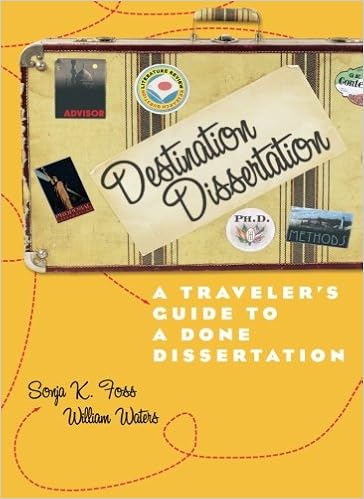
This book in particular, Destination Dissertation, I recently finished and thought I would post a review of it on my ePortfolio.
So, if we’re going to be traveling, I can’t think of a better trip….
Overall Impression of the Book
I would have to say, this book turned out to be much better than what I first expected and MUCH better than the other books I’ve read on the subject thus far. It did a thorough job of covering all the major topics like searching for a research question, completing a proposal, figuring out the literature review, collecting your data, even tips on writing, defending, and with additional tips on what issues to avoid.
I thought it rather strange that, though they either wrote this book (or at least updated it) in 2016, much of the text is geared around manual processes for data collection and notetaking. While I did enjoy the overview of their process, I would have to say it is not very relevant, given our technology today. I’m not certain who would still be taking notes on slips of paper anymore. Maybe…
The Ugly Truth
One key point brought up I thought was especially important is the authors statement, “we believe most students can complete dissertations within nine months, even while they are working part-time” (Foss, Destination, 17). This is rather key to the entire debate on the motives underlining much of academia in modern society. Is there a reason why a PhD must take 3-7 years to complete? Is there a reason why a Master’s program requires specific courses in order to graduate? The answer, unfortunately, is no. The credit system, the semester system – these are all artificial gatekeeping mechanisms put in place by accreditation organizations to keep out the “undesirable.” Mind you, not students. Rather, they want to keep out other institutions that do not have the money to play by their rules, keeping the pool of options for students much smaller. This limits competition for larger institutions and boxes out the smaller ones. Because of this, accredited universities must raise their tuition rates in order to pay for the high cost of accreditation, which in turns strips even more wealth from the individual student. Students in turn, because tuition is too expensive, have been tricked into thinking it is a good bet to leverage their future and take out student loans to fund an education they cannot afford.
If that were not enough, then the Universities lobby the government to pass laws stating that students can never discharge their student loans, even in bankruptcy, which in turns transforms the 20 year old student into a perpetually indentured slave to the system, never able to escape the debt they were lured into. Combine this travesty with the idea that Universities must pump out enough graduates each year to maintain their ranking and justify their accreditation status (Foss, Destination, 7). This, in turn, floods the market with too many graduates (because everyone is getting them and taking out massive debt to do so) and the student who is carrying $40-$100K with of debt graduates to the unemployment line, discovering they cannot secure employment anywhere other than at the McD’s drivethrough.
In all honesty, the educational system is a complete and utter scam perpetrated on the American people by its own leaders, who then turn and attempt to play on the peoples’ desperate indebtedness to garner votes for their despicable policies. Until people wake up and recognize they must diversify their opportunities, must reject the mandate that all children must go to college to become successful, this conspiracy will continue to spiral out of control, until everything is stripped from the masses and we will own nothing and the elites will own everything.
Their Process vs My Process
One issue I had with the book (which I already mentioned above) is their obsolete methods of collecting and organizing data and information. Their contention for manual, physical notetaking, coding, and sorting is the ability to make connections with the content visually. For me, this argument is unfounded. To be honest, I think physical processing and organization of data is insanity.
The idea of hand typing notes from a source seems like an exercise in pure frustration. Granted, if your source material is in printed form, this is almost a necessity. But I’ve tried using print sources in the past and it was nothing short of a complete failure. Using physical tags, typing notes – it was exhausting. I have since escaped the physical world of sources and now utilize only digital resources from various locations. Depending of course on your area of research (I’ve been pretty lucky), most if not all sources are available in some digital form. The best option I’ve found is PDF, if for no other reason than it preserves the print page number for use in citations. Combine this format with text-to-speech software that tracks progress with a highlighted (by word) cursor, I have been able to develop a speed reading system that is superior to not only printed material but also to traditional reading.
Whenever there is a note I want to capture, I do so by the copy and paste mechanism within the PDF software. No highlighting within the PDF. No note taking within the PDF. The copied snippet is then transfered and pasted into the summary page for the resource in Scrivener (my Research Notebook). Once a resource is completed and all snippets transferred, short form Turabian citation is added and quick searches are conducted on the original document to identify page numbers. This process produces not only a comprehensive set of notes for each resource, but that summary is stored in my Research Notebook forever and can be retrieved by name and by content search. Though the book’s first mentioned process of manual typing is objectionable, they do mention on the next page the more preferred (by me) process of copy and paste (Foss, Destination, 81).
Another difference in process I have from the book is their organization style. I skip the physical slips and sorting into piles (Foss, Destination, 90) for a better system of direct insertion of note snippets (with citation already included) into a comprehensive outline. By using Scrivener and keeping note snippets as individual documents, I’m able to move items around in the outline until the order is perfect (same process as their physical slips of paper, just not so much clutter).
Conclusion
Despite some of the major difference I have in theory and process with this book, I would have to say it’s been the best of the preparatory books I’ve read so far for dissertation research. It is, hands down, the first book I would recommend to all graduate and doctoral students in the future.
Foss, Sonja and Waters, William. Destination Dissertation: A Traveler’s Guide to a Done Dissertation. Rowman & Littlefield Publishers, 2007.
 Steven S Veach
Leave a comment