
As part of my Doctor of Theology program at Forge Theological Seminary I am completing several preliminary foundational “seminars,” including writing several articles on various topics.
This particular article focuses on an overall exposition of the program I’m undertaking and the methods in which I will employ to complete my research. So, let’s find out what my ThD will look like when I’m finished…
Overview of my Research
As I’ve outlined in other assignments, I’ve been studying Christian Philosophy for several years now, more specifically working to chisel out a philosophy of death (which is the purpose of Philosophy to begin with), to develop a most accurate understanding of the fundamental truth of reality, beyond theological axioms or presupposition. Part of this work has been recovering a biblical worldview rather than a denominational one. This has included gaining a familiarity in what has been described as the Enochian Worldview or the Divine Council Worldview.
Surprising to me, this preliminary work really set the stage for the main thrust of my dissertation and doctoral research that would reveal itself as Church Persecution from both a historical and a practical perspective.
Once I found Forge Theological Seminary and the unique opportunity they afforded me to complete this project, I got to work straight-away. Since then I have titled my dissertation, “The Great Apostasia: Preparing the American Church for Coming Persecution, which describes and analyzes not only the reasons why persecution will come to the Church in the US, but how American Christians can prepare to have a good testimony in the face of suffering if and when God calls them to it.
Any biblical Christian is fully aware (that is any Christian that is familiar with the biblical text and its message rather than one who is dogmatized by tradition alone) of the dramatic cultural shift that is occurring in the country as we speak. The conservative voice, the political right, Christians – all are experiencing systemic suppression of their ability to speak freely in the town square. In counter, we see the rise of a godless, secular worldview that promotes violence, racism, tribalism, and perversion all in the name of equity and fairness and revolution. But, those who are able to spiritually discern can see clearly there is nothing benevolent about their motivations, their actions, or their plans.
Make no mistake. This knew cultural shift wants nothing else but to burn down everything around them, to destroy every system, every culture, every means of trade, and replace it with a totalitarian reign of terror like which human history has never before seen.
How fitting it was, then, that my research and culture aligned in such a way as to make every disparate element of my life to finally come into a conducive whole. Not only does my life make sense now, and so does its future trajectory, but likewise does it explain the reason why my life has been as it has up until now. It has all been in preparation for this moment in time, and for what is surely to come. For this I am genuinely thankful to my God and my King.
Why I Choose a Non-Accredited Seminary and Specifically this Program
I wrestled with this decision for months, years in fact. I started grad school back in 2009, shortly after finishing my BA in History. But, a run-in with one of my professors led me to drop out of my program, thinking I was not cut out for graduate work. I spent years searching the internet late at night, looking for a grad program that was right for me. But it wasn’t until a year ago that I realized why the professor had been so harsh with me during my first attempt.
Simply put, she wouldn’t accept my work because I insisted on using the Bible as a historical document. Basically, she was flunking me because I was a Christian. But, not exactly. It wasn’t simply because I was a Christian. It was because I saw the world differently than she did. I give credibility to the legitimacy of the biblical account. It is accurate for inclusion in the historical record. And, sadly, the secular world is desperate to deny the Bible’s authenticity.
But, last year, during one of my midnight searches online, I discovered Liberty University has a Master’s Degree in History. I could transfer in my credits and finish up for about $5000. Long story short, though, this was misguided. Even though Liberty advertises certain prices, they have in place mechanisms that keep students enrolled longer, increasing the price dramatically. To make the story even shorter, through what I can only describe as the providence of God, I was able to finish an MA in Theological Studies for $500 and there I was, ready to enroll in Liberty’s PhD program.
But, the roadblocks were still there at Liberty. I could get a PhD from them for $7000 if they didn’t put artificial roadblocks in my way. But, in reality, it would cost me $14k. What I really wanted was a PhD program that was similar to the MA program I had just finished. Low to no cost. No semesters. No gimmicks. I also didn’t want to have to jump through a bunch of hoops, take arbitrary courses to fulfill credit requirements. I wanted to really dig into the research I was passionate about, that I was interested in.
There were a few schools I looked at, like the Antioch School of Theology, and Master’s International University of Divinity. There was also Columbia Evangelical Seminary and then Redemption Seminary (though I found out later they don’t actually have a doctoral program yet). I spent weeks searching for a program that would provide me enough flexibility to do genuine research while at the same time from an institution that still had some level of integrity not to bend the knee to the compromising culture or try to fleece the flock in order to enrich itself or its benefactors.
That’s when I was referred to Forge Theological Seminary. Unlike Liberty, which was extremely over priced and was showing signs of cultural compromise, FTS was not only taking an official stance against socialist pressure, but it also operated under the ethic of volunteerism. Faculty were all volunteer, church based, and, thus, students were fully funded in their programs (I.e no tuition costs).
I was immediately excited about FTS because, not only was it cost effective and ethical, but the program itself was modeled after Oxford doctoral degrees, or what is often termed, the “dissertation only” program. Now, this is somewhat of a misnomer, since there is a great deal more work involved in such a program besides the dissertation itself. At least for me. But, it is not formulated and systematized like it is in typical graduate programs, with pre-set courses and comprehensive exams, etc. The best way to describe it is to use an example from Oxford University itself:
“…students are encouraged to attend and contribute to a wide range of research seminars, workshops and conferences held within the faculty and across the wider Humanities Division. They are also encouraged to attend and participate in the faculty’s professional development sessions, preparatory teaching workshops and graduate teaching training scheme…” (University of Oxford, para. 3).
This was the approach I was looking for. A program with real flexibility. I would be required to produce results, but the path I used to get there would be up to me. I picked what lectures I needed to sit in on (such as James White’s Church History Course) and what materials I would use (i.e. a portfolio system).
Initially in my search I wanted to find a PhD program, and, if I had found FTS a few years before, they still offered PhD’s. But, at some point along the way, they decided to discontinue the PhD for the ThD (since they are not academically focused but rather are focused ecclesiastically).
One fascinating aspect is the issue of accreditation. Back in 2011 I dropped out of seminary because it was not accredited. I could not use that degree or that work to get a job in academia. Fast forward to today, even a degree from an accredited seminary will not help me get a teaching position, simply because the market is flooded and I am not culturally compromised. Yet, at least theoretically, the ThD program still qualifies me to teach/mentor at a particular Seminary that I’m very interested in working for. It would fit in perfect with what seems to be my trajectory in God’s call on my life. But, even if this does not work out in the future, I will always be able to teach/mentor on my own through podcasting, blogging, books, and online courses. There are even avenues I intend to explore concerning teaching/mentoring/discipling while under persecution as well.
So, at this stage in the evolution of the cultural shift we are experiencing, despite the door being closed on teaching in “credible” academia, doors and opportunities are being opened for me in alternative arenas.
How Does this Program Help the Church?
One of the issues I’ve wrestled with all of my adult life as a believer is how do my actions, my calling, help the Church? For the longest time I’ve felt as if I were an outcast, one who doesn’t fit in, simply because I saw no efficacy to the modern expression of Christianity in its professionalism, its denominationalism, its traditionalism, and in its over emphasis on wealth and power. But, suddenly, as the world turns upsidedown, I can, for the very first time, see the point of all my wandering in the proverbial desert. I can see why it would have been a mistake to try and fit into what I was not called to fit into.
Instead, this feels right and correct, to be doing this research now, at this moment in time, as these events in the world and culture around us unfold. Beforehand it would have made no sense at all. No one would have ever imagined the Church in America would be persecuted and driven underground. At least, not until now.
Here is a diagram illustrating the place my research holds in both the research topics themselves and in the larger Church proper:
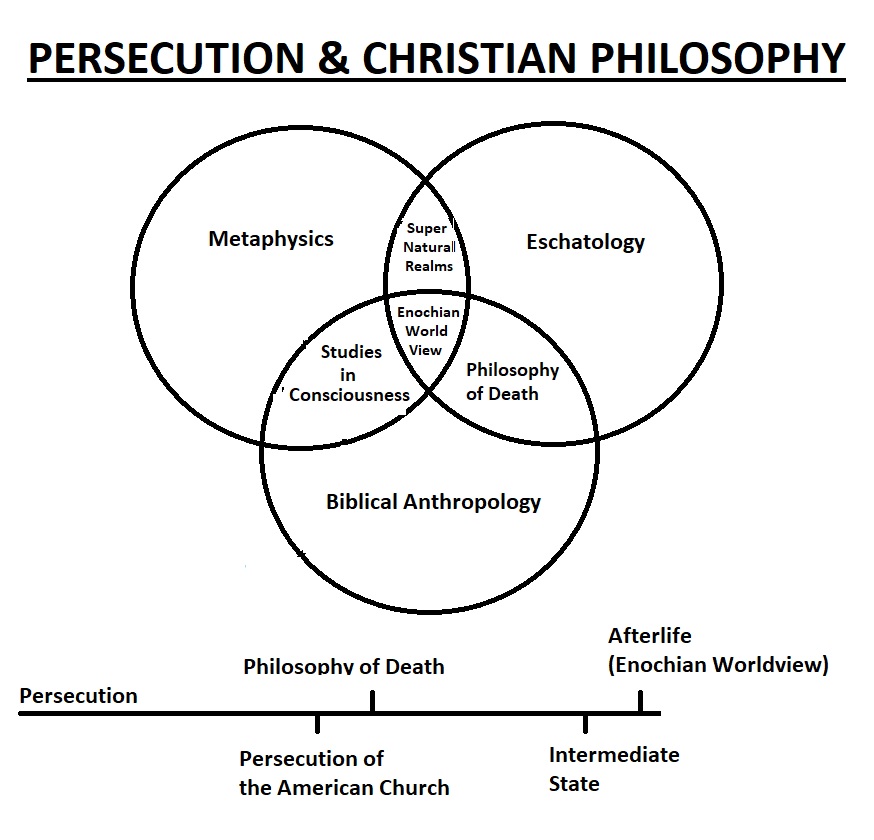
According to the diagram above, my research will focus intrinsically on Persecution, framed by a primal delineation of the Christian philosophical topics of biblical anthropology, death, the intermediate state, and the Enochian Worldview as expressed by Second Temple Period and New Testament writers.
Working from the top of the diagram, the three circled representation illustrates the main foundational areas of my research: Eschatology, Biblical Anthropology, and Metaphysics. It is the examination of the study of what is real and what occurs at the end, and likewise what transpires after the end that sets the stage appropriately for the exploration of modern persecution of the American Church in the context of historical persecution.
As these three areas intersect, such as with the basic makeup of that which we identify as the trichotomic human “living being” (body, soul, spirit) colliding with the universal processes of Eschatology, we see the human living being “appointed once to die, and then the judgment (Hebrews 9:27): the separation of the soul and spirit from the body, the spirit returning to God, the body to breakdown and return to the earth, and ultimately the soul to enter into the Intermediate State where it awaits the Resurrection. It is this series of fateful events, from birth to living, to aging and dying, to the untethering of that which constitutes the “living being” that I am to explore in developing a comprehensive Philosophy of Death – in how we die, why we die, what is death, and how it affects us in the future post-resurrection.
This frame of reference will serve in the greater purpose of determining by what approach we should view death at the hands of our persecutors. For if persecution does come to the American Church, how should those Christians view their own life? How should they view death as it approaches? How does a Christian prepare themselves for suffering for their profession – there, in the act of it, standing firm in their confession rather than faltering in capitulation?
From the left spectrum of the diagram, we see the secular inquiry through human interaction (biblical anthropology – for we are what we are regardless of secular denial) with Metaphysics or the study of what is real. It is the universal pursuit of investigation, of probing, of exploration that drives the human imagination and sparks the creative spirit within each of us. This brings to the front the fundamental question of consciousness. What is it? This goes hand in hand with the development of a Philosophy of Death to inform our approach to persecution.
Surprisingly, this diagram reveals a great deal, as we can see at the intersections of Metaphysics (reality) and Eschatology (future) we find what Paul describes as the Supernatural Realms (Ephesians 6:12). This is the greater spiritual reality that subsumes the physical reality we know and exist in as “living beings.” To be “alive” then, in this sense, is to exist and have our being in the material, physical dimension, which is a subset of the greater Spiritual Realm where God and the angels dwell. From our perspective – the biblical, anthropological viewpoint – this supernatural realm is defined as the Enochian Worldview, or that which was accepted by deuterocanonical and New Testament writers of the Second Temple Period. These two (Supernatural Realm and the Enochian Worldview) are the same, but simply exist diametrically only because of the fallen, human perspective applied to reality. Metaphysics, Eschatology, and the Supernatural Realms are what truly exist externally to us. Consciousness Studies, Enochian Worldview, and a Philosophy of Death are filters through which we view that external reality.
This leads, then, to the lower half of the diagram, with a time frame of history represented on the line, running from the beginning of history to the end, left to right. Persecution here is shown to exist throughout time, or, at least throughout the history of the Church (though an argument can be made to include the Prophets and also Adam and Eve being persecuted by the Serpent). Represented midway is the persecution of the American Church (future event), where the Philosophy of Death informs those called to martyrdom for their faith. Upon death, those who are martyred enter into the Intermediate State, awaiting the promise of the Resurrection. It is after the Resurrection where all understanding and wisdom and knowledge of the objective levels of truth (Metaphysics, Eschatology, and the Supernatural Realms) will be revealed, no longer requiring a filter through which to view.
This is a theory of everything, a means by which all the disparate components of theology and philosophy can be merged into a fluid and comprehensive understanding of the fundamental realities of nature, of our existence, of who God is and the purposes for which all of Creation (the physical dimension) was brought forth. Through this ToE, more questions can be asked of the nature of angelic beings, of the origin of God, of the fundamental forces at work in the Spiritual Realms, of what it means to become Sons of God, and how humans will be transformed at the coming of Christ.
How I Will Complete my Research
On December 12th, 2020, I submitted my Dissertation Proposal, which can be viewed here. This document outlines the major research question for the project: Why has the American Church abandoned persecution as a Christian rite, and what would be required in developing an effective Theology of Persecution for use in equipping the American Church for future suffering? This proposal was approved on December 13th, 2020 moving me to ThD Candidate status and formally launching my research project at FTS. I also created an online Proposal presentation that can be viewed here.
As a quick overview of my process going forward, I will need to finish all preliminary work which entails reviewing introductory material on how to conduct a doctoral research project, write up a dissertation, and then adequately defend it. Once this introductory material is complete and all writeup assignments have been posted on my ePortfolio, I will takes some time to critically examine the Dissertation Outline created for and submitted within the Dissertation Proposal. This Outline will then be transfered by line item into Scrivener (my word processor of choice).
When I’m satisfied with the state of the Outline in Scrivener, I will then proceed with the initial round of gathering source material. This will be in the form of ebooks, journal articles, dissertations, and first hand accounts when critical to the research. Of the resources available, a review of their citation and cross-reference information will be conducted in order to uncover additional resources. I will categorize each resource based on the subject matter and will then assign a summary file within Scrivener. Each resource will be run through a cursory analysis (skim), looking at the TOC, at the headers, at abstracts, and at book reviews, to determine if the text is of any special interest to the research in question. In addition to this initial investigation, I will also conduct several keyword content searches within each source text.
If a source is determined to contain valuable information, or to be on target with the research in question, that resource will be set aside and identified for reading in the future. Any notes that are pulled from a source during the keyword searching will be copied to the source’s summary page for later analysis. Each summary page will contain within it the proper bibliographic information in Turabian format.
Once an initial pass is complete of all available resources, a thorough analysis (read through) will be conducted of all so-identified sources that are deemed pertinent to answering the research questions. This read through of each source will be conducted using a text-to-speech software program, at a high rate of speed, with visual tracking, all to maximize the time committed to this task. All notes deemed important will be copied from the T2S program and pasted into the summary page for that resource. Once a resource has been read through and all notes extracted, a quick search of the original document will be conducted to identify page numbers for citation purposes. Short note-standard citations will be created at that time for each note on the summary page.
While the read through task is being conducted for each identified resource, an additional task will be undertaken to review each completed summary page and notes found relevant will be transferred to the Dissertation Outline. This two fold process will continue until all resources have been examined and all notes are transferred into the Outline.
A final review and line item edit will be conducted of the Dissertation Outline to make certain the thoughts and arguments stand up under a critical examination. At this point the first draft of the dissertation will be written from the Dissertation Outline. Once this draft is complete, a series of editing passes will be completed until the document is ready for submission.
Once the Dissertation is complete, a screencast presentation will be created and recorded, presenting the findings of the Dissertation. The Dissertation and the Presentation will both be posted on the ePortfolio. Afterward, a Defense Questionnaire will be drafted, with the researcher playing the role of committee chair, attempting to critically review the Dissertation and Presentation and develop as many probative questions as possible for the researcher to answer. An exercise will then be written up answering all the above cited questions in preparation of the actual Dissertation Defense.
Lastly, the Dissertation will be submitted to the Advisor and Committee for review. Once the reply has been received, all questions will be answered and returned, along with a copy posted on the ePortfolio as record of the defense. At that point it will be up to the Committee to determine the veracity of the research project and will approve or deny the granting of Doctor of Theology in Persecution and Christian Philosophy to the researcher.
Once all formalities are completed and the decision is made, notification will be placed on the ePortfolio to serve as final record of the decision. All other open items will be closed and the research project will be formally ended.
After the Research is Completed
Once the research project is completed and the degree conferred (or not), I do plan to complete several Post-Project tasks. First I will complete at least 3 journal articles from the research developed during the project. These journal articles will be submitted for publication in several different academic journals or, if unable to find acceptance, they will be posted on the ePortfolio as a record of the material along with the information about the Journals each article was submitted to and the denial responses provided.
Once the articles are completed (and hopefully published), I will proceed with converting the Dissertation proper into several workbook based courses to be distributed or sold via Amazon Kindle and through other avenues if censorship increases between now and then. These materials will be marketed toward individual American Christians, American Churches, and any Christian in the world. Marketing will be done through the development of a podcast focused specifically on Persecution coming for the American Church.
I will then use the degree, the research conducted, the podcast, the curriculum as a launching point in hopes of landing a mentor/teaching position at a particular Seminary (I have only two in mind, only one would be a paid, adjunct position, the other a volunteer position). Simultaneously, I will continue my research in Christian Philosophy and develop additional courses in other specialized areas.
I will also be developing the lake property for full time retirement in the future, where I can find solitude and isolation to continue probing the boundaries of the metaphysical foundations of reality and develop a ever deepening understanding and comprehension of God and my place in his plan and purpose.
Veach, Steven S. “The Great Apostasia: Preparing the American Church for Coming Persecution – Dissertation ePortfolio.” ThD Dissertation. Forge Theological Seminary. stevenveach.wordpress.com.
University of Oxford. “DPhil in Theology and Religion.” Oxford. 2021. http://www.ox.ac.uk/admissions/graduate/courses/dphil-theology-and-religion.
 Steven S Veach
Leave a comment