As part of my Doctor of Theology program at Forge Theological Seminary I am completing several preliminary foundational “seminars,” including reading through several books on dissertation development and production.
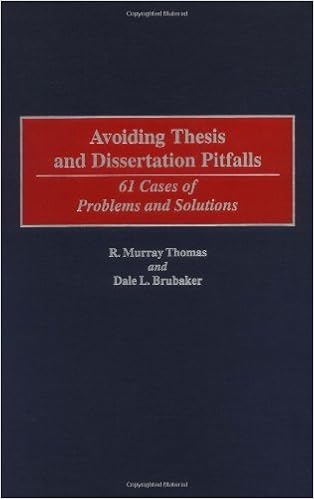
This book in particular, Avoiding Thesis and Dissertation Pitfalls, I recently finished and thought I would post a review of it on my ePortfolio.
So, let’s find out just what we need to avoid when writing up our research….
Overall Impression of the Book
My first comment about this book would have to be the format. Why in the world would anyone design a non-fiction book as a narrative, or a series of dialogues? It seems severely unnecessary. I suppose if the author was typically working in non-fiction. In fact, as I recall, I’ve had thoughts of doing non-fiction in narrative form in the past, though I’ve never actually attempted it. I can certainly say it did not work in this instance. The conversations between the professor and their student were often times trite and overdone. Whatever the intention, it simply did not work.
The book content did cover some interesting points, especially that of plagiarism. To this day I can’t imagine ever lifting other people’s work and trying to pass it off as my own. I guess that’s because I’m never wanton for something to write about. Writer’s block has never been an issue for me. But this example they provide where the student gets caught (Murray and Brubaker, Pitfalls, 170). It reminds me of my own brief time as a mentor at a fledgling online seminary where my very first student submitted his very first assignment: it was like 500 words and he still couldn’t do it.
It was immediately obvious that he was using someone else’s work. In our correspondence his English was not very developed. But, when I started reading his assignment, I could tell instantly the difference. It took a quick Google search of a line or two to confirm he lifted entire paragraphs, verbatim, from a theological dictionary.
After reaching out to my supervisor about the situation, it was determined that if the student confessed and showed remorse for the plagiarism that they could continue in the program and re-do the assignment. When I wrote to the student and brought up the issue, though, he was very defensive. He did not deny he’d done it, but simply stated that he was way too busy to do the work and needed to get his degree as soon as possible for the sake of his “ministry.”
There was another instance not long ago about a K-Pop star who was busted for plagiarizing her MA and PhD dissertations! Isn’t that insane? Hong Jin-young, a trot singer (wasn’t sure what that even way – still not – seems to be some strange form of polka) was busted by the media when recent scans of her MA thesis returned a score of 74%. She first denied it, but then finally admitted (via social media) that she had been pressured by greed to plagiarize.
So, maybe I’m naive. I certainly live in a tiny subset of the world, in a self-absorbed culture, in the “backwoods” of society. But, I have several problems with this whole situation. First, why does a K-Pop singer need advanced degrees? What would be the point? Second, why is the media running her thesis through plagiarism detectors? A hunch? Third, if she did do it, why would there be a financial incentive? Was she going to leave the entertainment industry and try and land a job as a professor somewhere? Do singers with advanced degrees get paid more? Was she planning to use her fame as a means of writing and selling books?
The whole thing just seems very strange to me. I get the guy I busted for lifting from the theological dictionary. He was trying to get a job that he wasn’t qualified for. He didn’t want to pay ridiculous amounts of money for the degree he needed. Plus he didn’t want to spend the years it would take to get a degree. So, he was trying his best to circumvent the system – so he could “get into ministry,” which is more often than not code for make money taking advantage of people.
Components and Ideas
But, this book wasn’t just about academic integrity. They also brought up issues with the literature review, and how they are not just catalogues of publications, but should be used effectively is showing how the research in question fits into the work already done, and how that previous work contributed to the current research (Murray and Brubaker, Pitfalls, 25)
For me, I’m still at the stage where I’m wanting to do something, but I’m not certain how that looks, or, once I get there, if I’ll even be able to recognize it. I do believe I have a substantial case of impostor syndrome, not certain my work is of any real caliber, not sure how to find out. I’ve submitted my proposal and thought there was a really good chance it would be rejected. But it wasn’t. It was approved. If I were at a university that was attempting to extract cash from me, I could see why they would push me along, even if there was no hope I would ever get a degree. But at FTS there is no tuition. Not to mention, the professors are all volunteer, so I see no shenanigans going on. I do feel as if I don’t have what it takes. I do feel as if I’m not certain I can express myself in a way in which people outside of my own head will at all understand me.
They also discussed the issue of interpersonal interaction, and more specifically, sexual harassment (Murray and Brubaker, Pitfalls, 69). I personally have no experience in this area. I’ve never been harassed in the workplace, and I’ve never harassed anyone. I’ve known a few women who bewail their attractiveness as a curse, stating the unwanted and unwarranted attention they got because of it was exhausting.
It just seems like an unnecessary risk to take, being in close proximity to others. But, I’ve been accused in the past of having relationships with coworkers, primarily because of the politics happening in the office. It’s not a fun experience at all, and really just proves my point. People are, by and large, terrible creatures. It’s best if they are outright avoided.
I did finally discover the difference between a primary and secondary source in this book. Apparently, a primary source is that which accounts for an event as furnished by an eye-witness (Murray and Brubaker, Pitfalls, 93), whereas a secondary source contributes the account of the same event, but does so without any witness involvement, and is usually second or third hand.
Some Final Thoughts
I was shocked when I came across the account of the professor teaching the graduate student how to log onto the internet. I get that this book was written awhile ago. But, seriously? How to connect to an ISP (Murray and Brubaker, Pitfalls, 28)? It might be time to update this little gem.
They go on to talk about how to conduct a search of the literature, which, again, was in narrative form. Most of what they bring up, though, is irrelevant now that much of what I consume is either in PDF form and sourced online through journal and ebook repositories.
I do agree it’s advantageous to review material before jumping head-long into it. As they make note, I typically will skim through a book’s TOC, or read a journal article’s abstract, or less frequently read a book review on a source before determining if it is worthwile enough to actually read it. Some text I never read, but will run several keywork searches on to see if it produces any usable notes. This is often the case on dissertations.
If I do read through an entire book or article, it is done in a text-to-speech program that speeds up my rate, plus allows me to quickly pull out verbatim material and paste into Scrivener as notes. Once I’ve gone through an entire document, I can go back and search the exact wording in the text to find the page number for citation.
This process generates a running collection of summaries for each source, with proper citations at the top, and in-text citations at the end of each note. I will later go through these and pull out each note and insert those snippets where they belong in my dissertation outline. This makes it easy when I go to write the first draft, the entire note is right here in the text with proper citation already provided.
Once I’m finished with a project, those summaries remain in the collection (my research notebook) and can be contextually searched whenever I’m looking for a specific piece of information or doing a broad search on keywork concepts.
Conclusion
As is typical with most books I read, this one is not very useful. It has some interesting points, but much of it is fluff. I would not recommend it as worthwhile for grad students. There’s really not much point.
Murray, Thomas R and Brubaker, Dale L. Avoiding Thesis and Dissertation Pitfalls: 61 Cases of Problems and Solutions. Praeger, 2001.
 Steven S Veach
Leave a comment