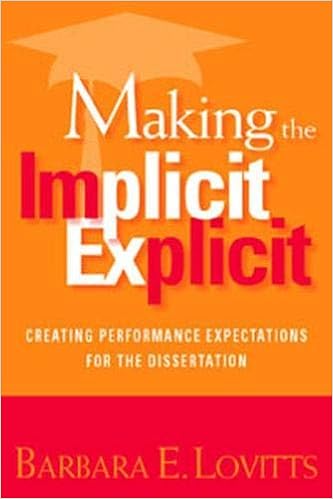
As part of my Doctor of Theology program at Forge Theological Seminary I am completing several preliminary foundational “seminars,” including reading through several books on dissertation development and production.
This book in particular, Making the Implicit Explicit was a kind of oddity I stumbled onto while searching for explorative material, but I couldn’t pass it up.
So, what was the draw? Let’s find out.….
I Didn’t Read it All
This book presented a very interesting and detailed account of the research project that undergirds the writing of the text itself. Focus groups were formed on several campuses of professors who graded dissertations (pg xi-xv). It’s quite interesting to see the work that goes into a research project. But, I found no useful information in most of the text. I read through Part 1 and skipped the Rubrics section (since I see no plausible future in which I will be sitting on dissertation committees) as well as the majority of Part Two, except for the section on the Philosophy Dissertation.
The Cost of a Doctorate Program
This book would be better categorized as a treatise for graduate level professors who are just starting out as an advisor in a PhD program or who would like to make a chance from the traditional mythic/magic approach that has too often been illustrative of the PhD and doctorate process. The author, apparently a doctoral student when writing this title (and quite possibly this book was originally her dissertation), sets out to argue that there is need for a systematization of the expectations for graduate students across the board and throughout academia.
I have to admit, I’m not certain I agree. At least, that is, I don’t agree with her assessment on what needs to be changed. In this book the author showcases how dissertations are typically assessed in today’s academia. She narrates the research she did with dozens of Universities across the country and several in foreign countries, establishing focus groups where professors and faculty in charge of Dissertations or who were involved in Dissertation Committees were given room to discuss and voice their opinions about the process.
The research brought to light some interesting realities about the nature of doctoral programs, but maybe not exactly the ones the author intended to highlight.
One issue she tackled right out of the gate is the issue of financial cost. During her own process, she recalls wondering, “why I was underwriting the reform of graduate education with my bank account—and still do” (pg xv)? It is a fear I had when I started looking at PhD programs. The question kept nagging me. Aren’t they all just scams? A means to separate me from money I don’t have? How many countless people do I know who have advanced degrees who are miserable? What about those (like myself) who got an undergraduate degree because that’s what everyone told you to do, only to find out it really doesn’t matter. Most jobs are not secured because you have a degree. It’s secured because you have the skills needed and you can sell yourself to your potential employer.
But, there are clear benefits to breaking free of the pack. The freedom to pursue your own interests, wherever they may lead. The ability to work projects to their completion rather than be ham-stringed by funding or other peoples’ agendas. It’s been a running narrative in my own head throughout my higher education. Why am I being forced to learn these things? Why does it always feel as if what I’m officially required to learn is a distraction from what I really want to learn – what I feel called to learn and explore?
The truth is, and this book highlights it quite well, academia and the pursuit of advanced degrees is more often than not a veritable scam perpetrated on the disenfranchised.
I realized, as did the author, the game is rigged no matter if you land the job or not. In the end you are still employed and shackled to the system, whether they be “shackles of golden handcuffs” or out and out chains of debt and despair.
She states, “the risk did not pay off as I had hoped,” (pg xv) which I can only assume means she didn’t receive a very good ROI on her PhD. But, the idea that completing a PhD automatically means security and financial prosperity is something the wealthy elites have devised to keep the masses in bondage. There are, in actuality, much greater and richer rewards than monetary ones, as the author is well aware. And this is a failure of the higher education system – of the education system altogether, for not truly and comprehensively educating children and young adults for the real future rather than the fabricated one.
The Contents of a Dissertation
This book goes into great detail about what a dissertation is, what is its purpose, and how it should be assessed. It discusses at length how, by way of the author’s research focus groups, advisors see the dissertation process as a means of evaluating students in their ability to produce something ‘‘original,’’ something ‘‘significant” in the way of contributing to the body of knowledge in a given discipline (pg 3). Yet, too often, such evaluative measures are cryptic and elusive, leaving many students scratching their heads when attempting to maneuver through the gauntlet of academic rigor.
Some faculty, though, argued against the very idea of “originality” (pg 32), stating their process is systematic, formulative, that researchers do not make new contributions, but instead, join in on an already active conversation.
Philosophy takes a similar view but for different reasons. They would argue for originality in theory but against its probability given the vast length of philosophical inquiry (pg 362). As Solomon puts it, “there is nothing new under the sun” (Ecclesiastes 1:9).
But, of course, this quickly leads to what the author calls a “dirty little secret” among those who take part in dissertation committees, concerning many areas of the document itself, but most specifically about literature reviews, “they are often (if not usually) inadequate, poorly conceptualized and written, and boring (pg 6).
Yet, for some reason, in the last 6000 years, we’ve failed to come up with anything better in developing advanced students and preparing them for academia and to be the next generation of scholars. But, much like America and her culture, our form of education has only been around for a few hundred years, and what we have today only a few decades. How feeble is the branch we’ve built it all on, and how quickly it could all come tumbling down to the ground.
Professors, Advisors, and Committees are not Gods
The author brings up an interesting subject, one I’ve wrestled since the events that prompted me to drop out of graduate school back in 2009 and then out of Seminary in 2010. The reality is, people are at the core of all human systems on this earth. Every government. Every culture. Every safety net. Every economy. The entire fabric of modernity is founded on and perpetuated by a being that, according to the Bible, is inherently flawed, corrupted, debased, and immoral. Let’s not sugar coat it, huh? God’s conclusion way back before this world we live in today, was that humans were essentially and unequivocally evil (Genesis 6:5). Think about that for a moment. If it is true, it means that every lofty motivation, every good deed, every purposeful intent to help is predicated upon evil intent. It doesn’t matter how good a person “is” or how often they do “good things.”
It is no different in academia, the saged old profession, the institution, the constitution of collected human wisdom. Yet, it is just as fallible as every institution and every effort by human hand.
The author states there is evidence for poor quality dissertations being passed (pg 4) and I have to ask why? But their argument isn’t that poor dissertations occur, but that poor dissertations are the failure of faculty and administration from ever allowing that student into the program to begin with (pg 372). This is a horrendous statement that only proves the skewed ideology of the Academy. I know of multiple scientists who received their degrees from reputable schools only to be mocked and smeared because those scientists, after graduation, broke rank and denied evolutionary theory. And it is the same now with the insanity we have today. Human judgment is faulty. It is biased. It is inherently evil. It is corruptible if not always already corrupted from the start.
The reality is, academia is a scam. It is a ponzi scheme with only a few spots at the top and the rest are worker bees. If you are accepted into a PhD program and then go against the sacred cows of humanism (even if the research and evidence leads you there), you will be branded a heretic and tossed out of the institution. If you invoke reason, you will be chided and smeared and your character will be assassinated. In fact, the US and the global community overall is so polarized there is no return to the center. There will never again be a point in time where people will seek the betterment of all, but will descent into tribalism and chaos, all so those at the top can maintain control and influence. Personally, I believe it is time to abandon secular education altogether. We need to stop fooling ourselves that human effort, human volition, or human wisdom is anything other than what it truly is: evil.
In the research the book is based on, the faculty were given a list of dissertation characteristics to be rated by importance. From the results, independent contribution was at the top. Originality and publishability was second. Yet there is no clear definition of either and the results beg the question: if most dissertations contribute only a little if anything toward the development of knowledge (pg 5) what really is the point? I would state the overarching point of the whole machinery is the accumulation of money by those in control.
The Apparent Elephant in the Room
This is the conclusion I keep coming back to when it comes to the state of Academia today. It is estimated that 15% to 25% of graduate students who advance to candidacy never complete the Ph.D. (pg 74). Yet, each year, over 40,000 people earn a doctorate degree at US universities but only 30% go on to postdoctoral positions (pg 27). That means 70% of newly gradated PhDs do not find positions in academia. 28,000 PhD, each year, leave school and go on to other things. Most never find employment in the same field they were trained in. There’s even a phenomena known as the McDonald’s Effect, where PhD recipients go on to prestigious careers in the fast food industry.
Yet, despite these statistics, children and teenagers are pushed through secondary educational indoctrination institutions and are convinced they must have college if they are to ever succeed. But really what they are being convinced to do is take out massive amounts of person debt that can never be repaid, can never been liquidated by bankruptcy, and has and will enslave generations to come. The United States Government and the Corporate Enterprise are a conglomeration of a criminal enterprise and the populous has no means of repudiation.
Overall, this book made a few interesting points, and sparked a great deal of my own personal animosities toward my country and my government. But, there was nothing in the text that really helped me while working on my own dissertation. Then again, maybe this was not the purpose of the text. That being said, I would not recommend the book to doctoral students. Spend your time elsewhere, or, if nothing else, just spend the time writing on your treatise and leave this book on the shelf.
Lovitts, Barbara E. Making the Implicit Explicit: Creating Performance Expectations for the Dissertation. Stylus Publishing, 2007.
 Steven S Veach
Leave a comment