As part of my Doctor of Theology program at Forge Theological Seminary I am completing several preliminary foundational “seminars,” including reading through several books on dissertation development and production.
This book in particular, From Student to Scholar, I recently finished and thought I would post a review of it on my ePortfolio.
So, let’s find out just what entails the transition between the two….
Overall Impression of the Book
The author does a pretty good job of covering some important subjects that affect the graduate student in general and the doctoral candidate in particular. He discusses several differences between undergrad studies and the kind of research graduate students will be exposed to. He talks about the dynamic relationships between the doctoral student and their advisor, describing the various levels of involvement from the student being left in near complete isolation to the advisor that takes on a more micromanagement role (pg 137). On a personal note I prefer the first option, but can see the advantage of having an advisor that is more involved in the process and the subject material. In my specific circumstance I knew going in, no matter what program I selected (that was available to me) I would not have this kind of one on one involvement, so I am thankful to find a program where less is more and I’m left with the freedom to work in solitude.
The book does cover some rather rudimentary tactics and approaches to getting the actual mechanics of writing the dissertation done. But, since I’ve never been one to struggle with writing in really any capacity, I see this information to be less than beneficial.
In fact, the author spends quite a bit on the phenomenon of Writer’s Block. To be honest, I find the whole concept of inability to write baffling. As a fiction writer, I struggle with many and lengthy bouts of self-doubt and disillusionment, wrestling with the stark realities of obscurity and the psychologically devastating trajectory of bottom-list career prospects, but never have I, when putting the proverbial pent to paper, found myself without words. In fact, most often, they tend to pour.
Even in the midst of the many times I’ve sworn off the writing endeavor altogether, trading the angst and fury in for the more comfortable and profitable office space cubical midway up the metal skeletons we humans tend to tether ourselves, the characters and thoughts and ideas still permeate to the surface. From them there is no escape, and it takes not long at all before I’m back huddled in a dark room, the dim glow of my laptop screen blinding the mind’s eye as scenes and plans and perils spill out onto the page.
The Cover?
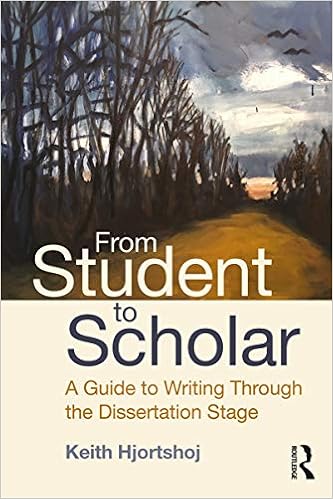
But I do have to comment on something rather abnormal about this book. Something rather captivating. And that is the book cover. To be honest I can’t say I’ve ever been as affected by a book cover as I have this one. There is just something about the stark colors, the browns, the blurred and jagged lines, the parched and beleaguered, scavenger infested sky overhead, the path that leads off into uncertain fate. It is the quintessential journey of the dissertation writer. Lost, unclear of what is required or what is preferred, unsure if there is enough time to arrive at the destination before the sun finally sets and hope is lost and squandered and forsaken. Needless to say, it is quite a cover, indeed.
Some of my Thoughts
But, maybe it would be more prudential to dig into the text itself rather than to quibble about it’s physical appearance. After all, there is so very much more to a dissertation than written words just pasted in place. It is research in its purest form. It is inquiry unmolested (at least should be) by greed or power or manipulation. The author talks about the writing of a dissertation (all writing in actuality) being a process rather than a finished product. He talks of the error of many writers when the first draft is mistaken for the last (pg 39). But, I have to confess, this is quite often how I write, with or without the intention of doing so.
As was liberally (and I would argue inappropriately) quoted, John Steinbeck once described the writing of his book Grapes of Wrath as a kind of “prison term” (pg 40). Yet, as I went the extra step to look up the actual quote from Steinbeck himself, I quickly discovered the point Hjortshoj was making was not exactly the point being made about the Grapes of Wrath. But, this is often the case when one author borrows the thoughts of another. Like memories, much of what we use is fabrication. We re-appropriate what is useful to our own agendas, filling in the gaps as we go.
The author does make a good point about the writing process overall, though. It can take much more time in preparing to write than it does to write itself (pg 49). In fact, I spend vast spans of time just living. Ruminating. And not in any conscious way. Not in any systematic or purposeful process. But, I often wait until the moment strikes, as if the writing itself had been somehow supernaturally and divinely preordained to occur at that moment, at that time, and only in that particular space. And it is true what Hjortshoj states, the graduate student spends a great deal of time reading, of taking notes, of thinking and ruminating (pg 49).
But, if left to the muse alone, we as writers are risking the inproductivity of inconsistency, as Boice’s research has borne out (pg 113). In fact, it was shocking to discover from this text, not only am I one of these inconsistent writers, but I’m also one who prefers writing to other forms of communication, simply because there is no audience, no judgment, no performance. For some strange reason, I despise performance and competition and being put on the spot. As the author brings up, “the poet William Stafford described writing as one of the great, free human activities” (pg 112) and he is so very right. I have, in the course of my adult life, written and published 9 novels. It is, if not a vocation (as I don’t make any real money), it is at least an avocation that costs me very little in monetary means, but it does serve as a great hobby and an even better therapist. I am, as an author of fictional people and imaginary worlds, able to live countless other lives. I’m able to step into God’s shoes, and work miracles and make the impossible possible. I can even step into my own world and muck around and cause calamity for the sake of the narrative, for the good or ill of those at my whim.
Toward the end of the book, the author takes up the bleak reality of completing a doctorate degree and the rather dismal job prospects awaking those who succeed. For a long time I held what the author described as “an idealized assumption” about what life would be like after getting a graduate degree. This, of course, is not all my own imagining. From childhood I was told by my parents, by my teachers, by my counselors, that my future was through education. There was no mention of my being born to poor parents in economic backwaters of the world, where there was little chance I would succeed beyond the menial job to begin with, but that there were vast numbers of culprits waiting to deceive me at every turn.
Yet, despite this, and despite the inherently deceptive nature of the higher education industry, I believe I’ve been spared a great deal of pain. At one time I had student loans, about $25,000 if memory serves. But, I was lucky enough to have a lifestyle that allowed me to pay off those loans in a matter of months rather than years. I also had the providential insight (not my own mind you) to abandon secular graduate school early on before that $25k turned into $50k or $100k. Certainly, walking away ruined any chance I had at a career in academia. But, looking back now, and looking now at the state of Academia today, I have to wonder if I had any genuine prospects if I had stayed in grad school anyway.
As the book points out, doctoral programs pump out way more PhD’s than there are positions to be filled. Even if I counted adjunct teaching into the picture (today you have to), I still have no chance of landing any kind of permanent position. Add to it my Christian profession and I’m automatically put into the discard pile. Given the low status of even my Regionally Accredited institutions, I have no chance of beating out applicants from Ivy League or even State schools. As stated, less than 15% of graduates will find employment in Academia (pg 179).
The author goes on to state the solution is not fewer PhDs, which I find rather an odd statement. The problem with reducing the number of people graduating with advanced degrees is we all know colleges, universities and even seminaries are not going to stop this train. The money is too good and the greed is too great. Likewise, most students are either ill-informed, self-absorbed, or are living in that idealized world bubble they and those around them have created for them to live in.
The solution he asserts is to educate students about the realities of the situation. And I think there is something to be said for this. Getting a doctorate degree is not a guarantee for a job in your future. It does not mean you will make a ton of money. In fact, quite often, it means, if you do land a secure job (and they really don’t make those anymore) you will more likely make less money and will most certainty be working much, much more. While finishing my Master’s degree, I began questioning if I really wanted to go on for a doctorate. In reality, I started questioning for two reasons. 1. The political and social and cultural insanity was starting to show up at the Seminary I had picked. 2. Once I graduated with my Master’s I would have to pony up the cash to get my PhD. I started questioning the cost. As the author in this book described it, I began “to doubt that the complicated, high-pressured life of a college professor suits [me] and are already considering alternative career options” (pg 181).
I started to realize that even if I could land a teaching job at a seminary, even if it was online, I really wouldn’t want it. I realized the job I had already outside of teaching and academia (that I landed because of my computer skills and the employer had trouble filling the position and not because of formal education) afforded me a much greater lifestyle and the freedom and funding to conduct my own research without all the hassle of working in academia. I realized my part-time job (2 days / week) could completely fund my research so I would never have to deal with all the negatives of the Ivory Tower.
So, I had to ask myself the question, what’s the point of getting this degree (pg 183)? And that question sent me searching for alternatives. I certainly couldn’t justify paying $14k for a degree when I would get nothing from it. But gone were the days of free education, and I was never going to get a scholarship.
But, then someone recommended Forge Theological Seminary and after a cursory investigation, I was hooked. And here I am, reviewing this book as preliminary work for my ThD program at FTS – a completely tuition free Seminary, where I can finish out my education and then go on and conduct my own research on my own terms, self-funded and free of all the trappings of modern academia.
So, I would have to say this book provides some insights into academia today, but only some. Is it a good read? It’s okay. Can I say it’s essental for anyone jumping in to the deep end of the doctorate? No. Not really. Better than some and not quite as good as others. But, I’m not certain I would recommend it to every graduate student I meet. Then again, there are few books that belong to that category.
Hjortshoj, Keith. From Student to Scholar: A Guide to Writing Through the Dissertation Stage. Routledge, 2018.
 Steven S Veach
Leave a comment